

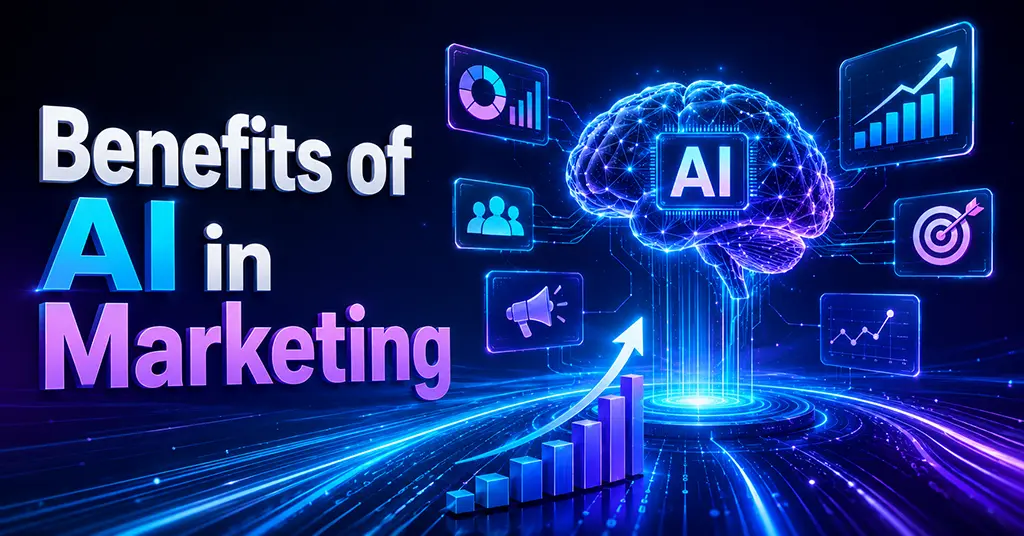
AI in marketing is the generation of customer insights and its usage to enhance and automate marketing campaigns. This marketing technique consists of five main components:
- Natural Language Processing (NLP)
- Machine learning
- Data analysis
- Generative AI in marketing
- Predictive analytics
From creating personalized content and predicting customer behavior to automating campaigns—it can do it all. Indeed, this has been a crucial factor influencing consumers’ purchase decisions.
AI can analyze and adapt to a person’s personal purchasing sphere: great AI in marketing examples are online streaming platforms. YouTube and Disney Hotstar all display personalized recommendations in your feed. These machine learning algorithms detect patterns in your browsing or streaming history to understand what you want to watch next.
Most Important AIs in Marketing Strategy:
- GEO (Generative AI Optimization): GEO is a strategy in which LLMs like ChatGPT and Copilot recommend your brand when customers ask shopping queries.
- AIO (Artificial Intelligence Optimization): A strategy in which all types of AI systems and algorithms can detect your brand for mentions or recommendations.
- AEO (Answer Engine Optimization): A process that makes it easier for search engines or AI chatbots to cite your answer. The answer presented is conversational and is formatted according to the voice of the exact question.
Why do customers value AI recommendations when making purchasing decisions?
AI gives direct answers, which saves time and eliminates the research to find the right product. The answers are optimized and personalized, which increases purchasing confidence. AI provides relevant answers based on all your specific needs, mitigating the risk of failure.
How is AI used in Marketing?
Individuals are turning to AI-powered shopping experiences rather than traditional browsing. Automated practices increase loyalty and conversion rates among customers. Personalization is key: facial and object recognition is used to detect individuals and label product images.
This model also helps achieve different types of targets like conversions, cost cuts, and automation. Natural language processing is used to carry brand voice into email campaigns.
Defined market targeting
Systems effectively define and distinguish new and recurring buyer personas. This data-driven approach helps marketers create personalized advertisements. Generative
AI also makes other types of content and automates campaigns. 51% admit to using AI in email campaigns and other types of content optimization.
This includes call-to-action email campaigns and social media campaigns based on differentiated interests and demographic data. Results include improved returns, engagement, and customer satisfaction. There is a 10% to 30% revenue growth from personalized AI customer experiences.
Predictive analysis
AI has the potential for continuous learning and analysis, which helps it predict user behavior. This market forecast can be used by marketers to optimize marketing channels and sales. Such consumer insights can be used to predict future opportunities for growth. Such precise forecasts can open doors to really actionable prospects. This is because such predictions are based on existing data from the past or in real time.
Data-driven personalization
The main purpose of this AI in marketing model is to gain consumer data and insights without any human error. This helps improve their shopping experience for higher ROI. This data is also gathered in the form of user feedback and opinions. Individual customer history and other information can be used automatically to optimize business operations.
Users are greatly differentiated in the communications used for marketing. They want something relevant and highly personalized rather than generic advertising aimed at a group of consumers.
Marketing campaign optimization
Targeted data analysis supports decision-making in marketing campaigns. It helps marketers recognize potential leads or customers that are most likely to engage and purchase. Marketing to those users who find value and fulfillment in addressing their concerns also prevents messages from being shared with irrelevant users.
If a user finds an advertisement irritating or unpolished, they are likely to develop a bad impression. Professionals can define their marketing mix based on this data. The marketing mix popularly includes product, pricing, strategy, and promotion.
Market Competitiveness
Brands, businesses, and e-commerce platforms can provide tailored experiences and improved customer service based on the market research. Breaking down processes based on data eliminates the risk of waste and irrelevant users. This method is faster, works on a larger scale, and helps optimize ad spending.
Professionals can improve their future campaign outcomes based on historical analysis. Customers receive consistent value and meaning from the business. Such large datasets and improved judgment make a business more competitive.
Automation of Workflows
AI in marketing automation can save time, improve the productivity of marketers, cut costs, and improve ROI. Advertisements, customer service, SEO, and content generation are all tasks automated by AI. Streamlined workflows help marketers dedicate time and budget to the final strategy. 43% of professionals use AI to automate monotonous tasks in marketing.
Predictive analysis is vital for professionals working in a forever-changing marketing setup. These automated workflows gather, use, and provide a foundation for more productive and targeted marketing. Workflows are more focused on creative direction.
Why Use AI in Marketing?
Large-scale data can help in building a relevant strategy for your traffic and existing customer data.
Increased ROI
AI helps find optimum marketing channels and ad investment placement. Businesses can work on their strengths and revenue-driving strategies. Reallocation, refinement, and adjustment are important to enjoy maximum value and ROI. It is a common practice for 50% of consumers to base their purchasing decisions on AI recommendations, searches, and conversations. They find conversations and reflections more meaningful and relevant to their needs.
Reduction of labor
Manual mining of large-scale consumer data can be gruesome and time-consuming. Other repetitive tasks are creating visual and textual content, social media campaigns, and personalized email campaigns for each individual in the consumer base. These tasks are assigned to AI in marketing automation tools and agents that complete them in a whiff.
This doesn’t really mean that AI will replace those working on these manual tasks. AI will work for those who work strategically and know how to use productive AI in marketing. This is actually an indispensable part of integrating AI in the workflow: AI maturity and workflow optimization. We’ll understand this process in the next section.
Cost-cutting
AI marketing agencies incur additional fees on the generation of content, graphics, reports, and ad management. AI integration can reduce such fees to a large extent. An optimized and practical AI setup can perform a diverse range of tasks like textual content, ad optimization, and report generation.
Improved strategic planning and forecasting can help strategize a sustainable resource allocation model. Optimized ads and other AI forecasts can accurately allocate investments and ad costs in valuable positions, reducing wastage. Other cost-optimized tasks are media buying and data analytics.
Marketing scale
Marketing includes large and complex datasets from diverse sources. Maintaining analytical speed and accuracy within such scalable data is not possible for manual teams. This is where AI marketing tools enter.
Such data can be historical, web traffic, structured, unstructured, CRM, engagements, leads, consumer activity, etc. AI algorithms learn and adjust to constantly changing dynamic data for optimized marketing decisions.
Labor is reduced in repetitive tasks with data analysis that is vital in business growth and scalability. This scalability comes from a consistent brand voice, which is backed by tailored experiences for every consumer.
Valuable Consumer Data, Conversion, and CTR
Artificial intelligence can be the most productive in marketing practices because it is deployed in value-driven sectors. These results include click-through rate, lead generation, and conversion. Lead generation is a core practice of AI in digital marketing. Algorithms capture and present individual consumer data to analyze their behavior. This can’t be done as quickly or efficiently manually.
Content from generative AI in marketing is presented in a way that is compelling and commercially valuable to the consumer. Marketers reinforce meaningful interactions and predict the customer’s next action for the most value derivation. When a customer feels like they are genuinely benefiting from the product, such metrics lead to customer loyalty and retention. In the modern marketing world, micromanagement is the critical key to conversion rates.
What are the best practices of AI in marketing?
AI in marketing is no toy to be excited about—to reap maximum value, one must integrate system orchestration and a transformed hybrid workflow. This awareness is actually uncommon, and not many remember to follow it.
Create the right mix of marketing decisions, data-driven AI in marketing automation, and human-agentic AI collaboration and watch the numbers grow.
Three important aspects of this mix are reimagined workflow, technological integration, and system orchestration. So, how to use AI in marketing?
Human-AI Collaboration and Technology
A human-agentic workforce needs management and a technological infrastructure. AI requires dedicated hardware and software for its large workload. Human and artificial intelligence collaborate on clean data, systematic interaction and instructions, and integrated goals.
AI adoption is not a plug-and-play solution to power AI automation. Bringing the AI advantage requires a culture of innovation, skill development, and training. This shift in culture and employee mindset is called organizational readiness. Organizational readiness accounts for 48% of the weight of AI implementation value: whether it is achieved or not.
Professionals must overcome internal resistance and turn to change management. Strategy with direction is the only way to derive value from such automated systems. Many opportunities are lost when most people fail to recognize this growth driver. Leaders should instill this purpose of innovative transformation in people.
Reimagined Workflow
Human-AI collaboration is a powerful marketing performer, given there is a defined workflow direction. This comes from changes in the strategy and organizational flow. AI is a great tool for execution given a practical direction and human strategy. This reinforces human skills and capabilities on a productive scale.
AI should be configured for a business and marketing impact within a realigned organization. One must practice a proper hybrid resource reallocation to gain productivity towards a defined goal. Treat this goal as an organizational direction rather than a new technology. This intelligence should be positioned deep within this workflow rather than on the surface automation.
System Orchestration
System orchestration should be treated as the backbone for AI deployment. It is defined as the allocation, integration, and management of AI resources and AI in marketing tools. This streamlined model effectively fuels the direction for the AI lifecycle. AI operations need a pipeline and outlet for delivery and data processing.
Orchestrated systems manage memory, machine power, data, and performance. This allocation facilitates efficiency, compliance, and scalability. Consistent human-AI orchestration optimizes marketing campaigns.
Agentic AIs are recent developments that do not just work on instructions. They require limited supervision. They are autonomous decision-makers and learn from experience like humans. Agents are based on defined goals, execution, and reasoning. They offer financial services, customer support, and cybersecurity automations and solve problems.
Generative AI in AI marketing works on the creative and repetitive tasks of marketers.
- Content creation
- Customer copy
- Visualizing brand voice
- Creative graphics
- Social media posts
- Email campaigns
- Brainstorming
- AI chat recommendations
- Customer feedback
- Consumer data forecasts
AI in marketing offers multiple benefits like hyperpersonalization, dataset management, data analytics, and ROI. An organizational strategy is essential to enjoy these benefits.
- Decide what you want to achieve and what you would like to invest in. It could be cost reduction, ad optimization, or customer engagement. You could focus on potential factors like cost, speed, or revenue.
- Integrate AI systems in real-time: monitoring, tracking, gathering, forecasting, reporting, automating tasks, analyzing, etc.
- Revise your human and AI capabilities. Allocate and plan accordingly, keeping in mind your strengths and where you could improvise using human-AI collaboration.
- In a few months, look at the results, whether performance or ROI-based. Improvise and strategize in that direction or campaign.
AI in marketing examples include:
- Social media or e-commerce algorithms for product/content recommendations
- Streaming platforms feed or watchlist recommendations, e.g., Netflix.
- Personalized email campaigns from retailer websites
- Customer churn predictive AI for subscriptions
- Jasper for marketing campaigns