


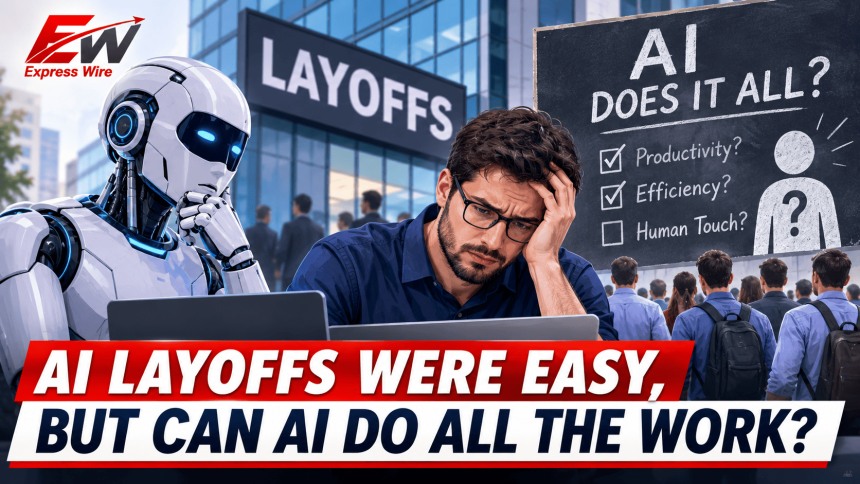
When the news of AI layoffs came too soon this year, everyone in the world was watching how AI would actually replace human professionals. This news has been anticipated for the last few years, but this quick decision backfired on a large scale. Are AI models just not as advanced yet, or can they never act or work naturally as humans do?
This layoff could happen again a few years from now, when companies think that AI is “optimized” enough to do so. But has the value of real human output, education, and skill sunk so low?
For now, many companies have rehired their employees after discovering their expectations from AI were too misdirected. Anyone who has researched present-day AI capabilities knows that AI continues to improve and succeed, but it has consumed unimaginable amounts of energy and wealth. No matter what kind of AI agent or automation one uses, it still needs human supervision. It has its own limitations compared to natural strategy and human-level execution, which employees are already doing.
This minimal research is critical for any company thinking about deploying AI systems, even more so for those “replacing” humans with AI. Before following any new trends, it is important to be sure of the possible outcomes. There is a flaw or loophole in every system or human.
AI has been recognized as the top reason for layoffs in 2026, according to 40% of employers who participated in the “trend.” As 2026 comes to an end, employees are reversing their decisions in a process called “AI rebounding.” Was it really so hard to predict?
32% of hiring managers claimed to have permanently fired a person for AI and then rehired to fill the human gap. Companies such as Amazon, IBM, Commonwealth Bank of Australia, and Ford are rehiring engineers as a defensive course of action. However, employees are refusing to return to these companies. Most of them want a pay increase, and some others want an agreement on job security. A demand for an apology or transparency isn’t the last thing on the list. Most expect this to be very hard to recover from and hard to return to the same level of productivity.
One can try to use AI positively, combining its powers with human context and guidance, try to learn to use AI guidance, and even try to find newer ways to position AI in the workflow. However, one can still expect these organizational transformations around AI deployment in the future and be ready to “embrace” change.
According to an SHL survey of 2000 workers in the USA, 19.1% said that they were laid off for AI and then asked to return. What does this mean? Employers need to have an objective and proactive view of their workers’ skills, which could significantly reduce the consequences of guesswork. The human workforce is willing to adapt and be more valuable compared to automated workflows.
The labor share of income in the USA is also falling because workers are becoming “less valuable” in the face of AI and new technology. While the US economy continues to grow, not everyone is benefiting from this expansion equitably. In the face of surging inflation, employer expectations are increasing, but wage growth fails to keep pace. This widening gap heavily impacts individual purchasing power while failing to account for shifts in the actual cost of living.